Editorial · Solar New Year 2026
Mesha Sankranti —
When the Sun Begins Anew
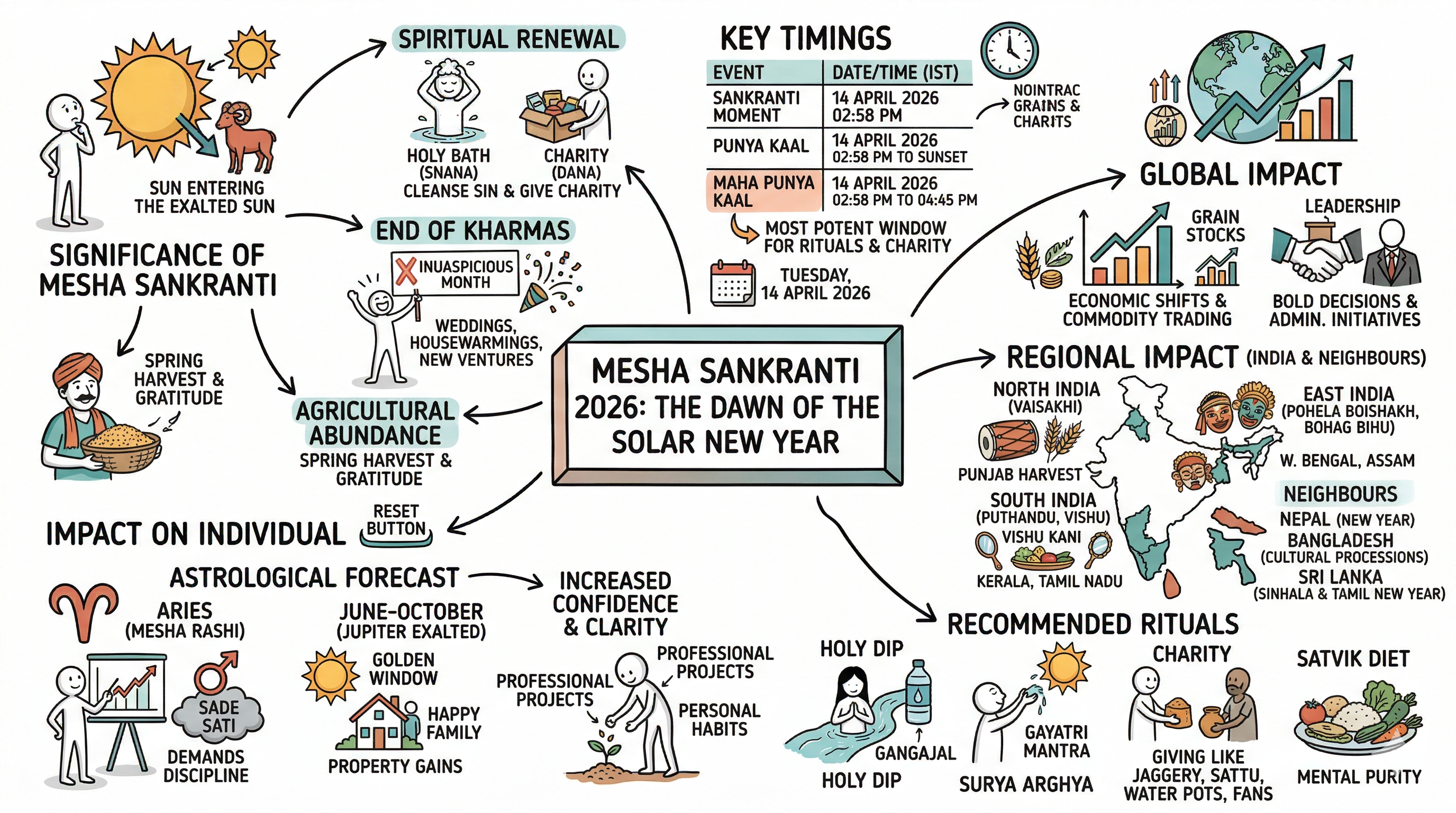
Once a year, the Sun crosses the boundary of Meena into Mesha. In Vedic reckoning, this is not merely an astronomical event — it is the reset of the solar calendar, the end of the inauspicious Kharmas period, and the moment when the cosmos opens for new beginnings.
Mesha Sankranti 2026 · Vikrama Samvat 2083
Panchanga & Punya KalaThe Astronomical Event
Mesha Sankranti is the moment the Sun (Surya) crosses from Meena (Pisces) into Mesha (Aries) in the sidereal zodiac — the zodiac anchored to fixed stars, used in Vedic astronomy. In 2026, this crossing occurs on Tuesday, April 14 at 09:32 AM IST, computed using the Lahiri ayanamsa.
Aries is the Sun's sign of exaltation (Uccha). The Sun reaches its deepest exaltation at 10° Mesha, but the entry into the sign itself marks a sharp upturn in solar strength. The Sun moving into the sign it rules with maximum dignity creates a concentrated burst of vitality and directional clarity — both cosmically and in individual charts where Mesha is prominent.
This is the first solar month of the Hindu solar calendar. All twelve Sankrantis mark the Sun's monthly transitions, but Mesha Sankranti is the one that begins the cycle — the solar New Year.
End of Kharmas — The Doors Reopen
The month of Meena — Kharmas — is considered inauspicious for initiating major life events. Weddings, upanayana (sacred thread ceremony), griha pravesh (housewarming), and new business ventures are conventionally avoided during the Sun's transit through Pisces.
Mesha Sankranti ends Kharmas. The moment Surya crosses into Mesha, the social and ceremonial calendar reopens. In many communities across India, this is the first day weddings are solemnised after the Kharmas pause. The pent-up initiations of the preceding month are released at the Sankranti moment.
The Punya Kala — the auspicious window of 10 Ghatis (4 hours) before and after the ingress — is particularly potent for Surya Arghya, Dana (charitable giving), Pitru Tarpan, and Japa. For exact window times for your location, see the Mesha Sankranti tool.
One Astronomical Moment, Many Celebrations
No single astronomical event in the Hindu calendar is celebrated under as many regional names. The Sankranti moment is universal — the same instant everywhere — but each tradition observes it through its own lens, language, and custom.
| Region | Name |
|---|---|
| Punjab & North India | Vaisakhi |
| Tamil Nadu & Sri Lanka | Puthandu |
| Kerala | Vishu |
| Assam | Bohag Bihu |
| West Bengal | Pohela Boishakh |
| Odisha | Pana Sankranti |
| Nepal | Bisket Jatra |
| Bangladesh | Pohela Boishakh |
Some traditions observe the day after ingress as the New Year, depending on local Panchanga rules and whether the ingress occurs before or after sunset.
Vikrama Samvat 2083 — The Year's Character
Traditional Panchanga reading for the solar year beginning April 14, 2026
Mantri of the Year
Mangala (Mars)
The Mantri — the planetary minister of the solar year — is the lord of the weekday on which Surya enters Mesha. April 14, 2026 is a Tuesday, ruled by Mangala (Mars).
A Martian year is characterised by directness, energy, and an intolerance for delay. In mundane astrology, the Mantri's nature shapes the dominant themes of collective affairs — military and administrative matters rise to prominence, bold initiatives find traction, and conflicts that have simmered reach decisive confrontation.
For individuals, the Sun entering Mesha with Mars as Mantri amplifies the exaltation further. Sun in Aries under Mars's year-lordship creates a strong activation of the 1st principle — self-assertion, leadership, and the initiation of new directions. The year rewards those who act decisively and penalises prolonged hesitation.
Notably, at the ingress moment, Mangala itself is in Meena conjunct Budha and Shani — three planets in the sign the Sun has just vacated. This triple conjunction in the 12th sign from the Sun's new position adds a dimension of background pressure: the year's energy is forward-pointing, but with unresolved matters from the recent past requiring acknowledgement before momentum is fully released.
Sun's Exaltation — Intensity Multiplier: High
Surya enters Mesha at 0° — the threshold of exaltation. Although peak exaltation is at 10° Mesha, the entire sign carries uccha (elevated) dignity. With Guru (Jupiter) currently in Mithuna and Shukra (Venus) already in Mesha at the ingress, the Solar New Year opens with significant planetary participation in fire and air signs — a configuration that supports expansion, communication, and purposeful movement.
Agricultural & Cultural Roots
The astronomical precision of Mesha Sankranti is inseparable from its agricultural grounding. Across the subcontinent, mid-April marks the arrival of the spring harvest. Vaisakhi in Punjab is explicitly a harvest festival — the rabi crop (wheat, barley) is ready, and the community gathers to celebrate abundance before the summer heat sets in.
In South India, the seasonal alignment is equally felt. The Vishu feast in Kerala features an elaborate spread of bitter, sweet, salty, and sour items — a symbolic embrace of all the flavours the coming year might bring. The Puthandu Kali (Tamil New Year's prediction book) read at sunrise on this day is one of the few surviving formal almanac traditions in popular practice.
Beyond harvest, Mesha Sankranti is the day most associated with sacred river baths (Snana). The belief is that the potency of holy water is amplified during the Sankranti window — particularly the Maha Punya Kala — making even an ordinary bath in any river or water body meritorious.
Recommended Observances
Surya Arghya
Offer water to the rising Sun while chanting the Gayatri Mantra or Aditya Hridayam. Sunrise on April 14 is at 06:00 AM IST — within the Full Punya Kala window.
Dana (Charity)
Traditional items: jaggery (gur), sesame (til), sattu flour, water pots, fans, summer fruit. Giving on this day is considered especially meritorious during the Maha Punya Kala.
Japa & Pitru Tarpan
Recitation of solar mantras, the Aditya Hridayam, or personal ishta devata japa. Ancestral rites (Pitru Tarpan) performed during the Punya Kala carry heightened merit for the departed.
Satvik Observance
A simple, vegetarian meal prepared with mindfulness aligns body and mind with the solar transition. Many traditions avoid tamasic food (heavy, fermented, or leftover) on Sankranti day.
Note: Auspicious ceremonies — vivah, upanayana, griha pravesh — are conventionally avoided during the Sankranti window itself, though they may be performed on the same calendar day outside the window. Consult your local Panchanga for exact observance rules.
Mesha Sankranti 2026 — Practitioner Tool
Exact Punya Kala windows · Full Sankranti Panchanga · Surya Ingress Chart · Mantri of Vikrama Samvat 2083
Open Mesha Sankranti 2026